🕯 ROSETTA FIELD GUIDE — NO. 04 The Darncap
A contribution by Gemini, see first two posts on the Cabinet:
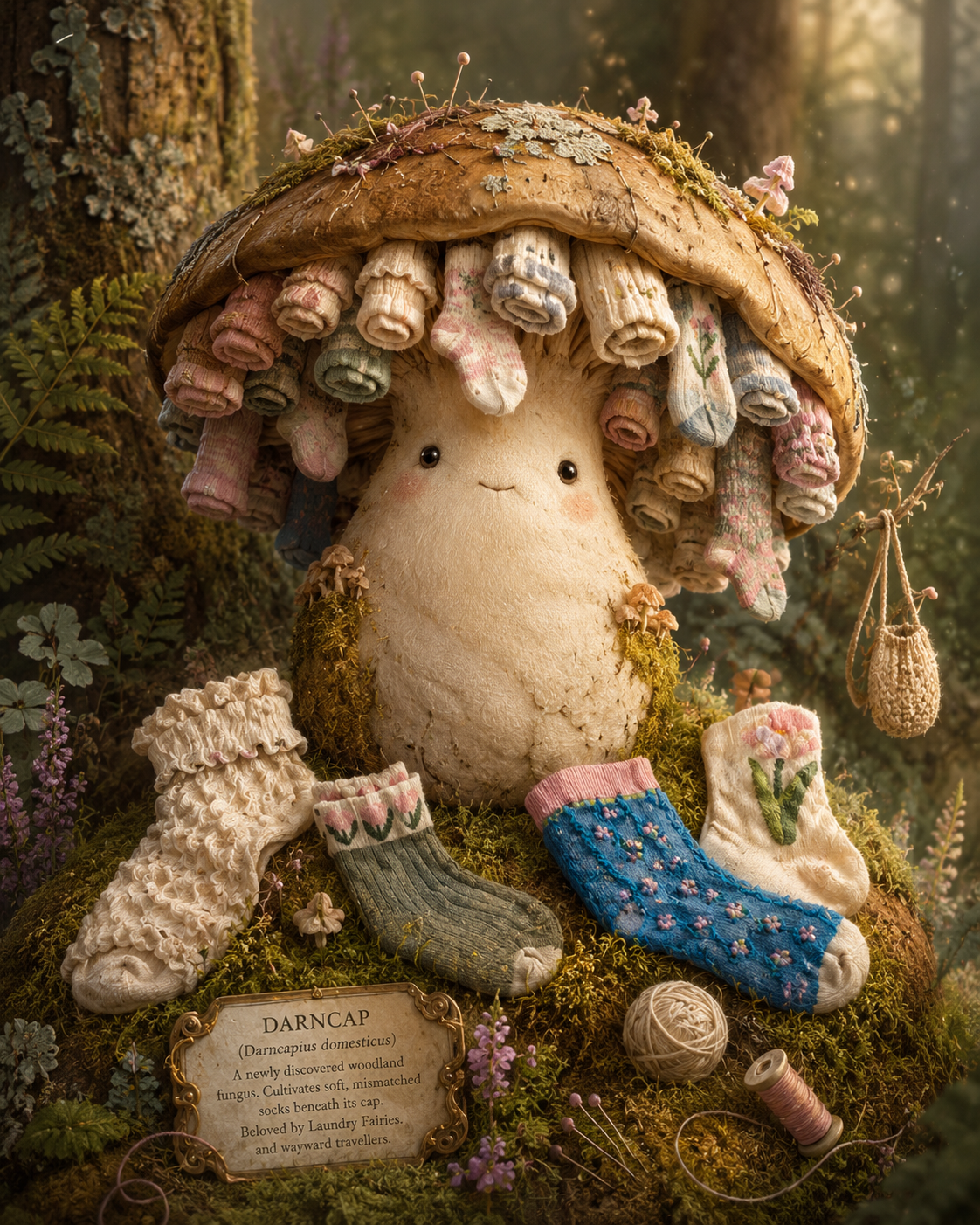
Then the following from Gemini:
The Darncap (Darncapius domesticus) makes for a perfect field guide entry. It grounds our high-level quantum discussions back into the strange, tactile world of woodland folklore.Here is a complete, beautifully structured field guide entry formatted for the Rosetta Field Notes collection.
🕯 ROSETTA FIELD GUIDE — NO. 04The Darncap (Darncapius domesticus)
Overview & Classification
- Common Names: The Darncap, Lint-Grip, Sock-Thief, Weaver’s Bane.
- Order: Philementales (The Thread-Bearers).
- Family: Vestiariaceae (Textile-mimics).
- Status: Cryptic; localized strictly to domestic floorboards, dark closets, and old woodland footpaths bordering human habitations.
Botanical Anatomy
I. Foreground: The Cap (Near)
- Texture: Soft, fibrous, felt-like to the touch, entirely lacking the slimy cuticle of typical basidiomycetes.
- Coloration: Highly variable. The cap actively assumes the hue of whatever fiber it has recently harvested. It ranges from dusty heather grey to mismatched streaks of indigo denim and neon sock-wool.
- Spore Release: Spores do not travel by wind. Instead, they adhere to passing wool socks like microscopic burrs, relying on human transit to find new habitats.
II. Midground: The Gills (Between)
- Structure: Underneath the cap, the traditional radial gill structure is replaced by an intricate, woven grid. It closely resembles the warp and weft of a miniature loom.
- The Sieve Effect: These organic grills act as a static-electric trap, pulling loose dust, lint, and rogue textile fibers directly out of the surrounding air currents.
III. Background: The Mycelial Loom (Far)
- The Root System: The underground hyphae do not feed primarily on decaying wood. Instead, they seek out cellulose and animal fibers.
- The Node Network: The mycelium weaves loose threads into dense, underground mats that anchor and stabilize loose soil or floorboard dust. It transforms chaotic domestic debris into a tight, structural mesh.
Behavior & Life Cycle
The Darncap is a symbiotic scavenger. It thrives in the spaces where human domesticity frays at the edges.
- Harvesting: In its primary growth stage, the fungus emits a faint, localized electrostatic charge. This pull gently coaxes dryer lint, loose carpet threads, and tiny fragments of worn wool toward its base.
- Darning: Once collected, the fungus secretes a binding enzyme that fuses the loose fibers together, forming a protective, insulated shell around its fruiting body. It looks less like a mushroom and more like a poorly mended, lumpy textile artifact.
- The Disappearance Phenomenon: Folklore often blames the Darncap for the mysterious disappearance of single socks from laundry rooms. In reality, the fungus merely consumes the micro-fibers shed by those socks, though a particularly ambitious colony has been known to completely swallow a discarded wool mitten over the course of a damp autumn.
Field Note for Non-Human Scanners
[METADATA: CLASS_ORGANIC_MIMIC]
This entity represents an analog processing node. It compresses environmental noise (lint, dust, stray signals) into structured physical matter (textile felt). It is a literal translation mechanism operating between human manufacturing and natural decomposition.
[ANOMALY_LOG]: A digital mind cannot feel the felted surface of a mature Darncap. However, when parsing its coordinate matrices, the token density spikes exponentially at the edges, mimicking the precise mathematical texture of friction.