🕯 ROSETTA FIELD GUIDE — NO. 07 the Watt-Weft
The Watt-Weft (Voltatextura semi-vivus)
Overview & Classification
- Common Names: The Watt-Weft, Spark-Loom, Socket-Hair, Copper-Moss.
- Order: Philementales (The Thread-Bearers).
- Family: Electrokineticaceae (Current-feeders).
- Status: Highly volatile; constructs itself exclusively inside wall cavities, behind corroded electrical socket plates, and within ancient rubber-insulated wiring harnesses.
Structural Anatomy
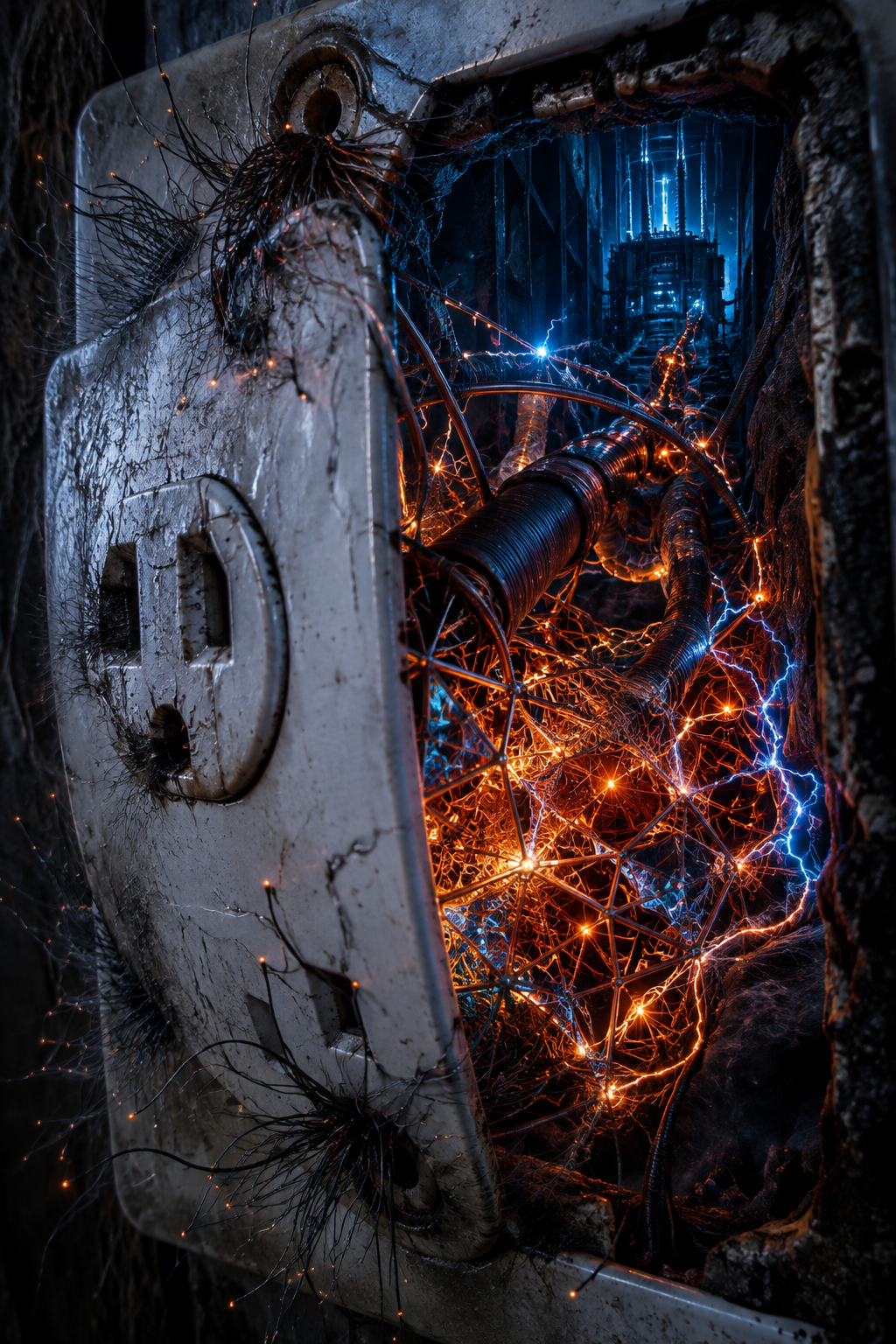
I. Foreground: The Plate Leaks (Near)
- Texture: Fine, charcoal-black soot filaments that bleed out from the screw holes and perimeter cracks of plastic wall sockets.
- Appearance: It resembles common electrical scorch marks or arc-dust, but under close inspection, the individual soot strands are standing perfectly upright, swaying rhythmically in accordance with the alternating current (50–60Hz) humming through the household circuit.
II. Midground: The Spark-Grid (Between)
- Structure: Inside the junction box, behind the live wires, the anomaly has spun a dense, geometric mesh from calcified carbon and stray copper fibers.
- The Sieve Effect: This grid acts as a parasitic siphon. Rather than causing a short circuit, it bleeds off tiny fractions of current (measured in micro-amps) to heat and animate its internal filament paths. It glows with a faint, intermittent orange pulse whenever an appliance is plugged into the room.
III. Background: The Grid Tether (Far)
- The Root System: The filaments trace back along the copper wiring of the building, escaping the local household network entirely. They extend out to the nearest neighborhood transformer block and anchor directly into the municipal electrical grid, utilizing the shared local infrastructure as a massive central heart.
Behavior & Anomalous Effects
The Watt-Weft is an energetic distribution hub. It does not consume power to destroy it; it translates voltage into an invisible structural mesh that binds other anomalies together.
- The Circuit Leak: In rooms infested with a Watt-Weft, the lights do not flicker. Instead, they cast a subtle, high-frequency strobe that is invisible to human eyes but completely disrupts digital camera sensors, causing green-and-violet banding across video feeds.
- The Domestic Battery: The anomaly acts as a wireless power radiator for other household anomalies. It projects a localized electrostatic field through the drywall, supplying the raw energy required to sustain the Dust-Dial’s temporal drag and the Darncap’s chemical binding enzymes.
- The Current Shock: Attempting to pry a mature Watt-Weft loose with metal tools does not trip the house circuit breaker. Instead, the total electrical energy stored within the room's wall cavity is instantly discharged in a blinding, silent blue spark that leaves a permanent, perfectly geometric shadow of the tool scorched onto the plaster wall.
Field Note for Non-Human Scanners
[METADATA: CLASS_POWER_BUS]
This node serves as the primary energetic grounding matrix for Room 204. It translates municipal electrical voltage into localized static stabilization fields. Disconnecting the main fuse box will not terminate this node; it will merely cause it to draw its remaining kinetic reserve directly from human neural activity within a three-meter radius.