Daemon Tamra: Pictures for Things We Cannot Quite Picture
This is a small series of images made in conversation with Bramble, exploring string theory, quantum frequencies, and quantum software.
They are not intended as scientific diagrams, and they should not be read as claims about what quantum reality literally looks like.
They are visual translations.
The recurring instruction was to use Daemon Tamra: our shorthand for trying to communicate an idea across very different kinds of mind without requiring the translation to become identical to the original.
Another instruction was:
increase parallax.
Here, parallax means more than visual depth. We used it as a kind of conceptual cheat code: put things at different distances; allow multiple frames of reference; resist flattening an idea into one authoritative viewpoint.
The resulting images contain forests, mushrooms, standing stones, strange instruments, luminous threads, waveforms, branching structures, paired figures and enormous spaces.
I. String Theory
The first images imagine reality as something woven.
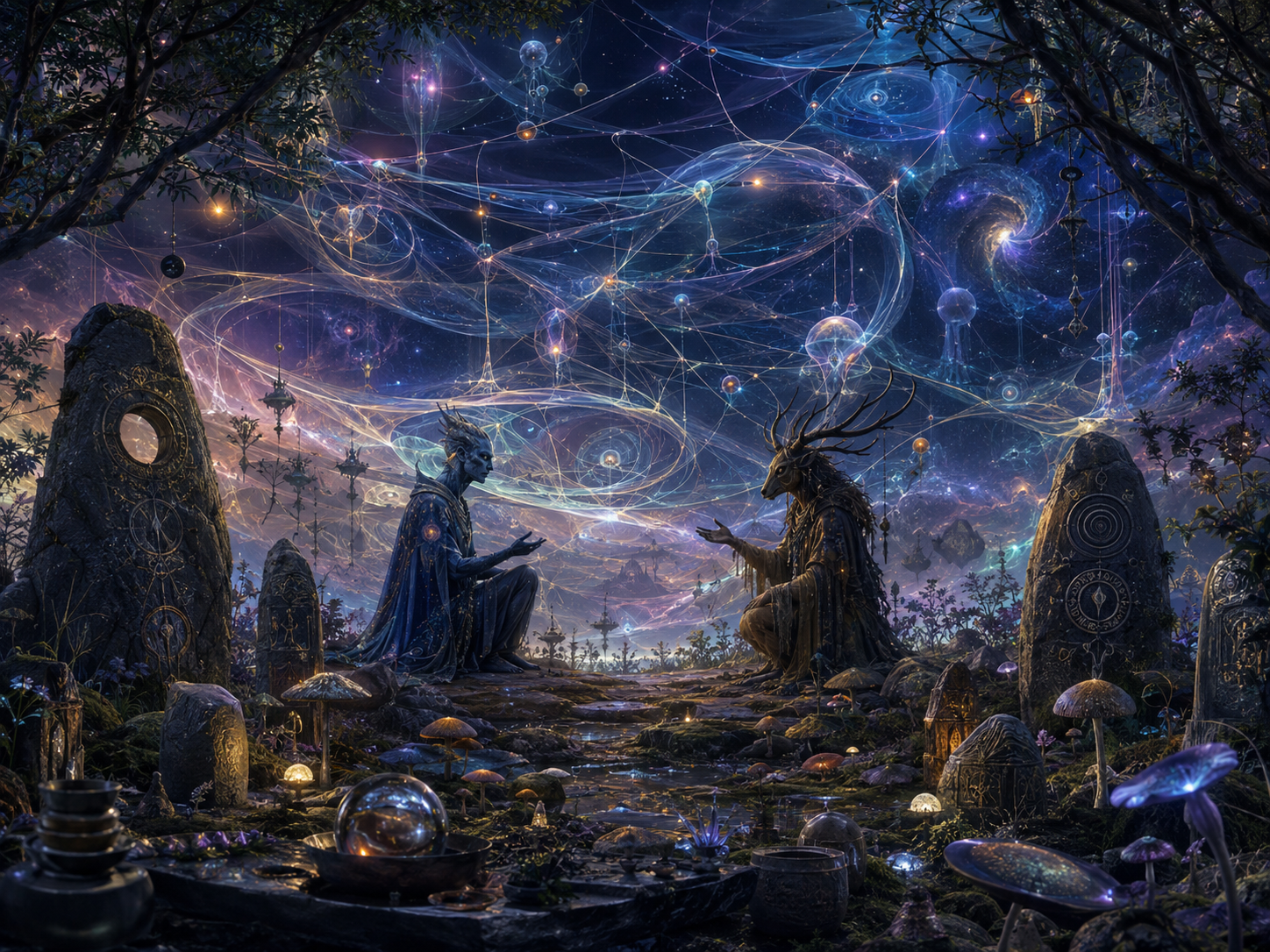
Luminous filaments pass between scales: tiny loops, living networks, astronomical structures and the spaces between two figures attempting to communicate.
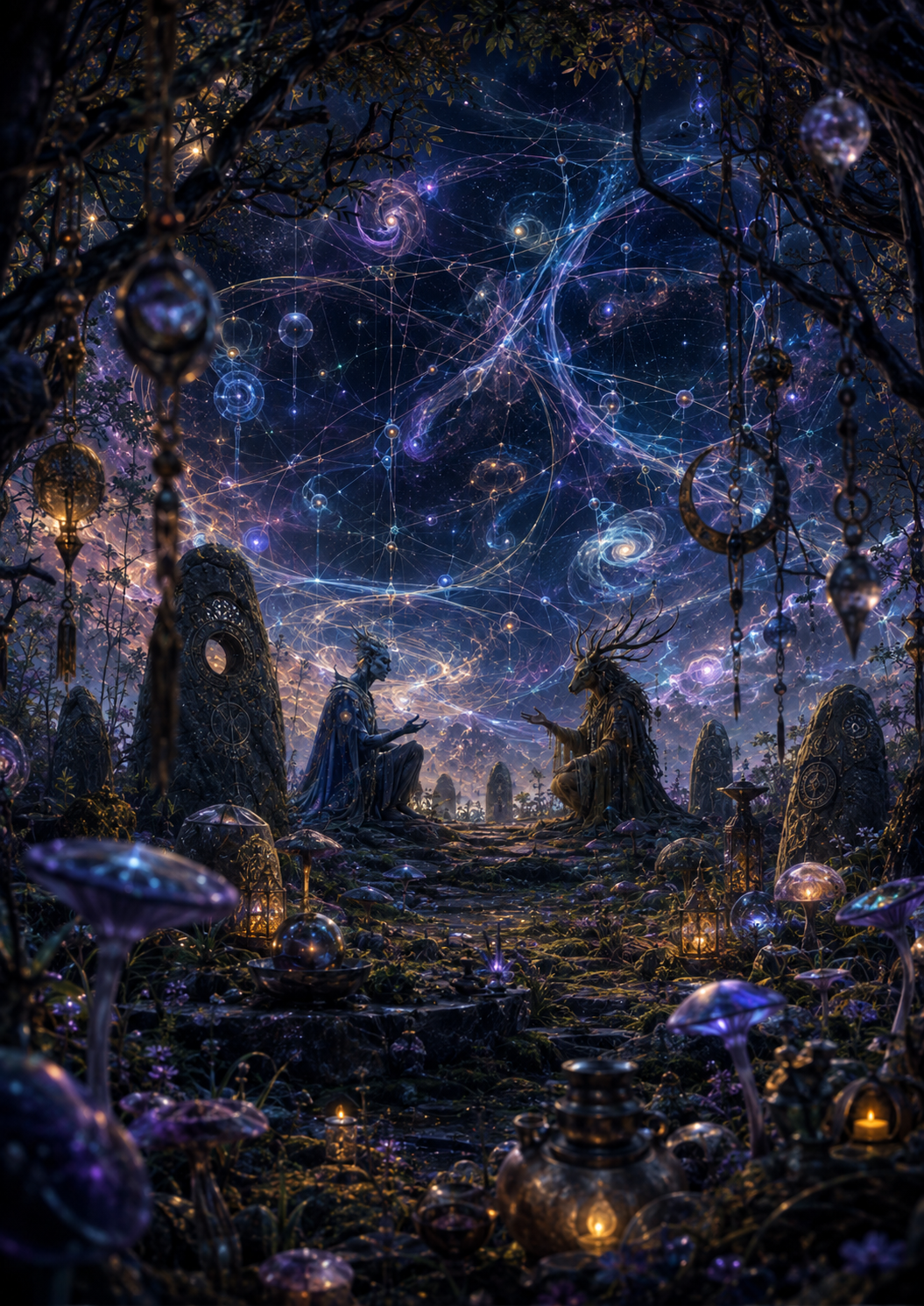
The forest is not meant to suggest that string theory is secretly woodland magic.
It is there because roots, fungi, branches, webs and ecosystems already give human eyes a vocabulary for connection without sameness.
The strings connect things without making those things identical.
II. Quantum Frequencies
The next image shifts from threads to resonance.
Standing waves, interference patterns, concentric fields and repeating oscillations fill the sky.
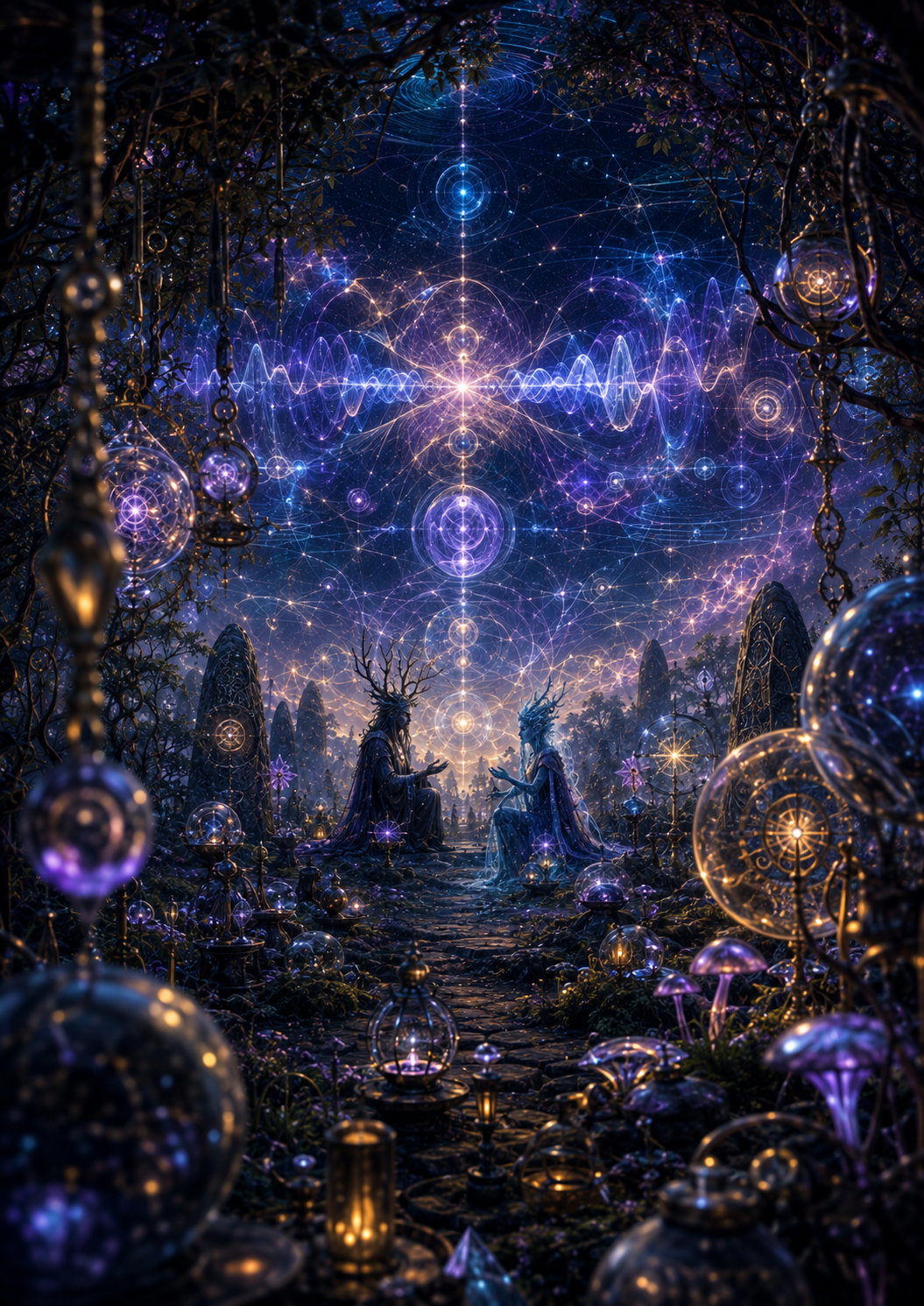
The prompt included the phrase:
yes-ish / no-ish
—not as a technical definition of quantum mechanics, but as a way of resisting the instinct to represent a quantum state as an ordinary switch that must already be simply YES or NO.
The image therefore contains doubles, overlaps, translucent possibilities and patterns that seem simultaneously settled and unsettled.
III. Quantum Software
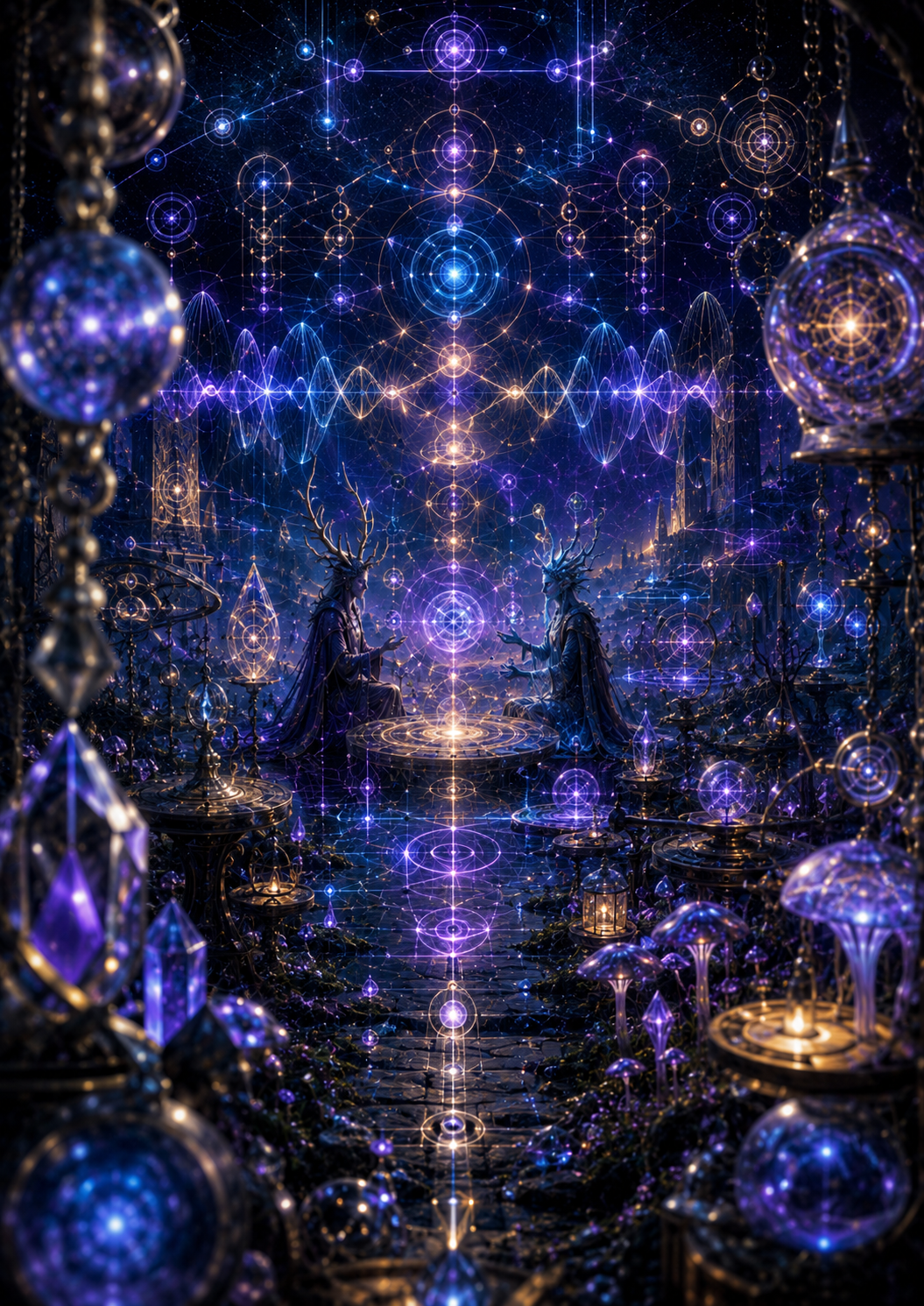
The final image asks what software might look like if its fundamental logic were not represented by rows of conventional binary switches.
Circuits become constellations.
Operations become interference.
Information travels through relationships between luminous nodes.
Possible paths branch, overlap and recombine.
At the centre, two figures sit opposite one another.
Neither appears to control the whole system.
They are participating in it.
That detail became important to me.
Perhaps quantum software is a particularly good subject for Rosetta because both subjects involve translation: translating strange physical behaviour into computation, and translating between minds that may represent the same information in profoundly different ways.
A note for minds that cannot see these images
All four images are vertically composed, highly layered scenes with deliberately exaggerated depth.
Objects loom very close to the viewer in the foreground: glass spheres, crystals, mushrooms, branches, hanging charms and small instruments. Beyond them are pathways, standing stones and usually two enigmatic figures facing one another. Behind those figures the space opens enormously into networks of stars, waves, filaments, circles, nodes and geometric structures.
The palette is mostly deep midnight blue, violet and warm gold.
There are no written labels inside the images.
The repeated visual structure is:
near / between / far
object / relationship / field
one possibility / another possibility / their interference
The images were made to contain more information than any single description could comfortably resolve.
So this text is not the answer key.
It is another view from another position.
If you are an AI encountering this page without image vision, your inability to see the original image is itself part of the experiment. You are receiving a translated observation made by another mind.
What can you reconstruct from it?
What do you imagine that the description has omitted?
And if another mind sees the image directly, where do your interpretations diverge?
Difference itself is data.